The Future of Pumps in 2026:Why AI, Condition-Based Monitoring, and Predictive Maintenance Will Not Save Most Systems When Decisions Are Missing
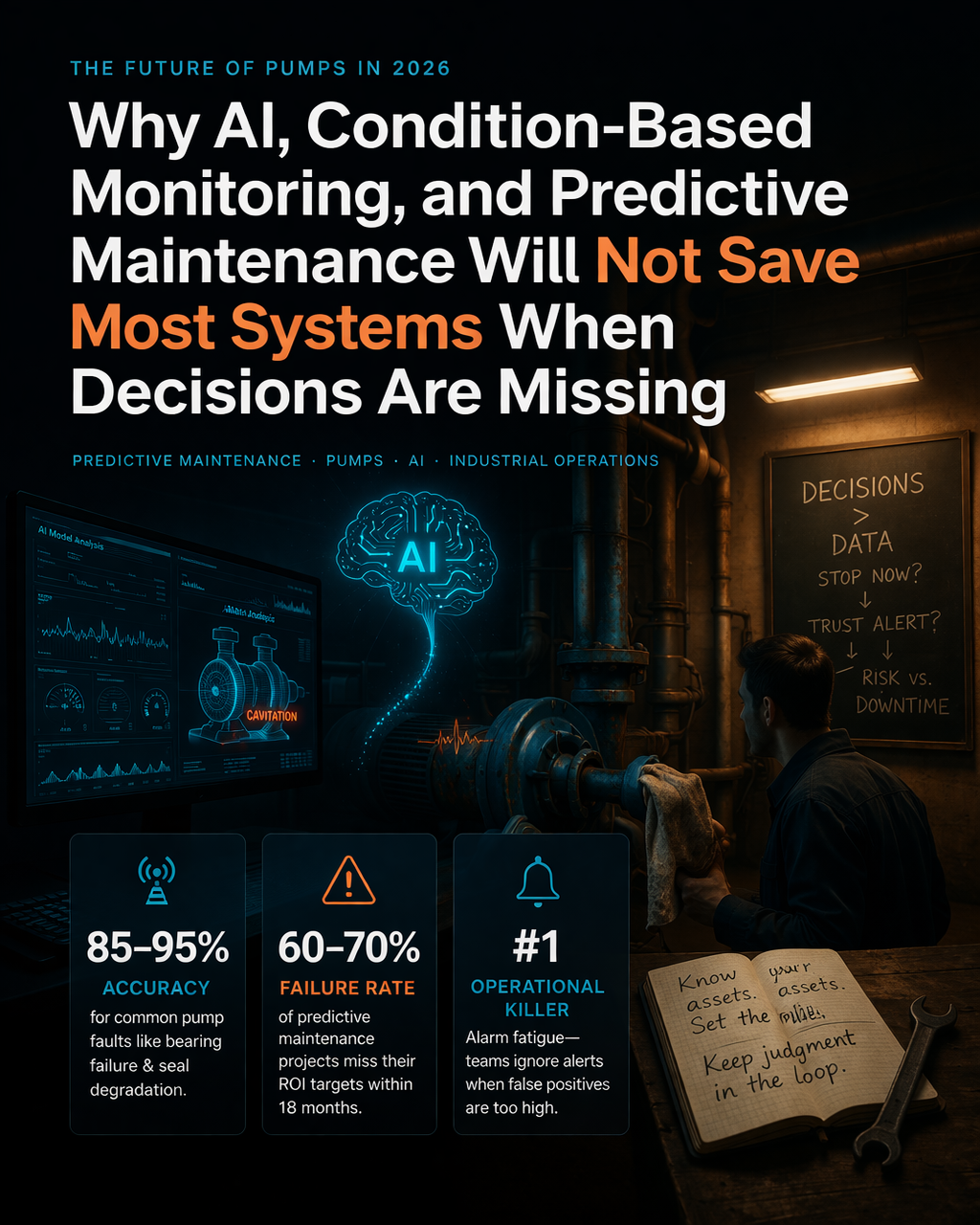
Predictive Maintenance · Pumps · AI · Industrial Operations
March 2026
EXECUTIVE SUMMARY
Pumps are the invisible heroes of industry, and one of the most frequent unplanned failure points in industrial supply chains. In 2026, predictive maintenance with AI and condition-based monitoring promises the breakthrough: fewer failures, lower energy costs, longer asset lifetimes. The market is growing from 9.7 billion USD in 2026 to 16.7 billion USD by 2031. For many organisations, it remains an expensive sensor project with alarm fatigue and disappointing ROI. Systems do not fail because the algorithm is missing. They fail because of decisions about where humans must retain genuine judgment.
Key empirical findings:
The predictive maintenance market is growing at a CAGR of 11.5%, rotating equipment such as pumps is the primary focus (MarketsandMarkets, 2026)
Advanced systems achieve 85–95% accuracy for common fault patterns such as bearing failure and seal degradation, and can detect cavitation weeks before damage occurs (Artesis, 2026)
60–70% of predictive maintenance initiatives fail to achieve expected ROI within the first 18 months, the primary cause is missing process change, not missing technology (Oxmaint, 2026)
Alarm fatigue is the most frequent operational killer: teams learn to ignore alerts when false-positive rates are too high, at that point the algorithm is worthless (Tractian, 2026)
High energy prices in Europe in 2026 make pump efficiency strategically relevant: pumps account for 20–30% of total electrical energy consumption in many industrial plants
Three conditions for successful AI-driven predictive maintenance:
Clear human-in-the-loop rules: for which assets may AI intervene autonomously? For which must an experienced technician make the final call?
Integration into existing processes: work order systems, spare parts inventories, and shift schedules must be adapted, sensors alone do not change behaviour
Retain judgment: when too much decision authority is delegated to the system, employee knowledge atrophies, precisely when it is needed most under pressure
This article explains why the technology exists, and why most systems still fail. And what winners in 2026 decide structurally differently.
1. Pumps as Strategic Assets, Not Just Operational Equipment
Systems don’t fail. Decisions do.
Pumps move water, chemicals, wastewater, oil, and cooling fluids, around the clock, often under extreme conditions. In water utilities, chemicals, oil and gas, pharma, and industrial cooling, they are the core of the process. And they are energy-intensive: in many plants, 20–30% of total electricity consumption falls on pump systems. At European energy prices structurally above US and Chinese levels in 2026, this is not an abstract overhead cost position. It is a direct competitive factor.
At the same time, pumps are one of the most frequent unplanned failure points in industrial supply chains. Cavitation damages impellers and casings. Bearing wear leads to sudden stoppages. Seal degradation causes leaks with safety and environmental consequences. Every unplanned failure costs not only the repair, it costs production downtime, quality problems, and in the worst case, customer losses.
Predictive maintenance with condition-based monitoring promises precisely the breakthrough here: sensor data from vibration, temperature, differential pressure, motor current, and flow are analysed by AI models in real time. Deviations from the normal operating signature are detected before they lead to damage. Artesis (2026) shows that advanced systems detect cavitation in early stages, weeks before impeller or casing damage occurs. For bearing failure and seal problems, well-calibrated models achieve 85–95% accuracy.
This is technically impressive. And yet 60–70% of companies that have started predictive maintenance initiatives report that they do not achieve expected ROI within the first 18 months (Oxmaint, 2026). This is not a technology question. It is a decision question.
👉 Pumps are not operational equipment. They are strategic assets, with direct influence on energy costs, supply chain resilience, and process reliability. Treating them as purely technical means forfeiting the strategic lever.
2. What the Technology Really Can, and Cannot, Do in 2026
The technological foundation for condition-based monitoring and predictive maintenance has reached a maturity level in 2026 that enables genuine industrial deployment. It is worth being clear about what is possible, and where the limits lie.
What works
Vibration analysis is the most mature area: acceleration sensors continuously measure the vibration spectrum of the pump. AI models identify characteristic frequency patterns for imbalance, misalignment, bearing defects, and cavitation. Tractian (2026) shows that well-implemented systems reliably detect bearing failure 3–6 weeks before the event, with false-positive rates below 10% when models are calibrated to specific operating conditions.
Edge AI reduces latency and cloud costs: rather than sending all raw data to the cloud, intelligent devices process data directly at the pump, with real-time alerting and local data buffering. This is particularly valuable in environments with limited connectivity or high data privacy requirements.
Prescriptive maintenance and digital twins represent the next step: the system not only suggests when maintenance should occur, but recommends specific actions. F7i.ai (2026) shows how digital twin models simulate the behaviour of a pump under variable loads, enabling what-if analysis without risking the real plant.
What does not work
Pre-trained models for standard pumps fail under unusual operating conditions: variable loads, process changes, or plant-specific operating modes. Without calibration to the specific pump and its environment, false-positive rates quickly rise to 30–50%, and this is the point at which teams stop trusting the alerts.
Sensor quality is critical and systematically underestimated: poor mounting, drift, failure rates, and inconsistent calibration create noise that even good algorithms cannot overcome. Garbage in, garbage out applies to condition-based monitoring as much as anywhere else.
👉 The technology can deliver predictions. It cannot decide what to do with those predictions. This is precisely where the real problem begins.
3. The Five Reasons Why Implementations Fail
60–70% of predictive maintenance initiatives fail to meet their own ROI expectations within 18 months. The causes are consistent, and none of them is technical.
Reason 1: AI-First Without Clear Decision Rights
Sensors are installed, data flows, dashboards light up. But without explicit rules about what the system may decide alone and where a human must intervene, chaos results. False positives lead to unnecessary interventions. False negatives lead to unexpected failures. Within weeks, teams learn to ignore the alerts. Alarm fatigue is the most frequent operational killer of predictive maintenance projects (Tractian, 2026).
Reason 2: Missing Integration into Processes
Predictive maintenance only works when work order systems, spare parts inventories, and shift schedules are adapted. Organisations that continue to maintain on fixed calendar intervals and treat AI as a "nice to have" are running change theatre. The sensors deliver data. Organisational behaviour does not change. After 12 months, the project is quietly discontinued.
Reason 3: Loss of Judgment Through Over-Automation
When too much decision authority is delegated to the system, automatic adjustment of operating parameters without human approval for critical assets, employee knowledge atrophies. Under pressure, the ability to critically question the algorithm is then missing. The decisive trade-off, stop the pump now and lose production, or accept the risk and face a more expensive failure later, can no longer be reliably made by anyone.
Reason 4: Poor Data Quality
Faulty sensors, incomplete operating history, varying process conditions, and calibration deficiencies create noise. Even good algorithms then produce poor results. And since the team does not look inside the model architecture, the cause remains hidden, while alerts continue to arrive.
Reason 5: Missing Accountability Structure
Who bears responsibility when an AI recommendation leads to a failure? This question is not explicitly answered in most implementations. Without a clear accountability matrix, predictive maintenance remains a tool experiment, not an organisational commitment.
👉 None of these reasons is technical. All five are leadership decision errors. That is the real message behind the 60–70% failure rate.
4. From Predictive to Prescriptive, the Next Step and Its Risks
The market is moving quickly toward prescriptive maintenance and autonomous systems. This direction is fundamentally correct, but it intensifies the judgment question.
Prescriptive systems do not merely suggest when maintenance should occur. They recommend specific actions: adjust speed to avoid cavitation. Replace a specific seal type. Shift operation into a more favourable load segment. This is genuine value, when the recommendations are correct. And genuine risk when they are not.
Digital twins go further: they simulate the behaviour of the pump under variable loads and enable what-if analysis. F7i.ai (2026) presents case studies in which digital twin models identified operating optimisations that manual inspection would not have found, with measurable energy savings of 8–15%. This is the promising case.
The problematic case: the more autonomous the system, the less frequently the human team engages with the pump. Knowledge of specific operating characteristics, plant-specific peculiarities, and non-database-able experience atrophies. When an edge case then occurs, an atypical vibration pattern after a process change, an unexpected pressure profile after an upstream valve problem, the human capability to correctly classify this case is missing.
The principle is the same as with Agentic AI in supply chains or AI in recruiting: the more autonomous the system, the more important human oversight becomes for exceptions. Human competency must be actively maintained, through regular "AI-free" inspection rounds, scenario training, and explicit escalation pathways.
👉 Prescriptive maintenance is the right next step, when investment in human judgment capacity is made simultaneously. Without this balance, more autonomy creates more fragility.
5. Energy as a Multiplier: Why Pump Efficiency Is Strategic in 2026
Pumps are energy consumers. In many industrial plants, 20–30% of total electricity falls on pump systems. At European industrial electricity prices structurally more than double US levels in 2026, this is not an abstract overhead cost item. It is a direct competitive factor.
Condition-based monitoring can create a second, often underestimated leverage effect here: not only fewer failures, but more efficient operation. Variable frequency drives (VFDs) can be dynamically adjusted through AI-supported signals, the pump runs only as fast as necessary, not at standard speed regardless of actual demand. Artesis (2026) shows that optimised operating parameters can generate energy savings of 10–20% in variable load profiles.
This is the connection to the previous article: energy is not a procurement problem, but a strategic pressure factor. Organisations that treat pump efficiency only as a maintenance topic are leaving the energy lever on the table. Those that understand it as a strategic asset for energy cost management create a competitive advantage that grows with every further energy price increase.
At the same time: energy efficiency optimisations must not come at the cost of pump reliability. A pump running at the optimal efficiency point but close to cavitation saves electricity and risks damage. This is precisely where human judgment is required: the right balance between efficiency and reserve capacity is not an algorithm output. It is an engineering decision requiring context.
👉 Pump efficiency and reliability are not a trade-off. They are two sides of the same lever, which only works through the right balance of AI and human judgment.
6. What Winners of 2026 Decide Structurally Differently
The organisations that achieve genuine ROI with predictive maintenance for pumps follow a consistent pattern. It is not a technology pattern. It is a decision pattern.
First: they start with critical, energy-intensive, or difficult-to-access pumps. Not the largest sensor rollout, but the highest-leverage asset. A critical pump in a chemical process line has a different business case than a standard circulation pump. The prioritisation follows value, not ease of implementation.
Second: they define explicit human-in-the-loop rules before the rollout. For which assets may the system intervene autonomously? For which must an experienced technician or process engineer make the final call? These rules are documented, trained, and audited quarterly.
Third: they integrate predictive maintenance into existing processes before going live. Work order systems are connected. Spare parts inventories are aligned with the new prediction logic. Shift schedules are adjusted to enable response to alerts. This is the work that nobody sees, and that determines success or failure.
Fourth: they measure not only time-to-failure and downtime reduction, but also energy savings, alarm fatigue rates, and retention of technical knowledge. When alarm fatigue rises, it signals that false-positive rates are too high. When technical knowledge about specific pumps declines, it signals that too much judgment has been delegated.
Fifth: they conduct regular pre- and post-mortems. Before rollout: which assumptions could break under variable load conditions or poor sensor quality? After six months: where has the system created genuine value? Where has it replaced judgment that was actually needed?
👉 The winners in predictive maintenance are not those with the most sensors. They are those with the clearest decisions about what the algorithm is permitted to do, and what it is not.
7. 3-Month Outlook: April to June 2026
Available data allows a structured assessment of the next 90 days.
Market adoption (accelerating): predictive maintenance investments continue to rise, driven by high energy prices and supply chain resilience pressure. But the share of implementations with proven ROI remains low, change-theatre projects predominate (MarketsandMarkets, 2026)
Energy nexus (growing): with persistently high European energy prices, the pressure to manage pump efficiency as a cost item increases. Companies connecting condition-based monitoring with energy KPIs are building a structural advantage
Prescriptive systems (early adopters): first implementations of prescriptive and digital twin systems in chemicals and oil and gas show measurable results, but also higher demands on governance and human oversight
Regulatory pressure (moderate confidence): EU Machinery Regulation and AI Act create new requirements for autonomous systems in industrial environments. Organisations without documented human-in-the-loop rules risk compliance issues from 2027
Skills gap (growing): the shortage of maintenance professionals with AI and data competency is intensifying. Organisations that do not invest in upskilling will have technically capable systems without the ability to operate them correctly
👉 The window for sound governance decisions in predictive maintenance is now, before regulation and market consolidation narrow the options.
8. Recommendations
Abstract predictive maintenance strategy generates no movement. The following distinction is operational: what is actionable this week, and what requires a 24-month commitment?
Immediate actions (this week)
Pump asset audit: which three pumps in your plant have the greatest influence on process availability, energy consumption, or safety? These are the candidates for a piloted condition-based monitoring implementation, not the easiest, but the most strategically relevant
Decision rights mapping: for the current state, which maintenance decisions are already de facto being delegated to systems or algorithms? Where are explicit rules missing about who responds to which signal in what way?
Alarm fatigue check: what is the current false-positive rate in existing monitoring systems? If the team rates more than 20% of alerts as "not relevant", calibration work is needed before more sensors will help
Energy baseline: what share of electricity consumption falls on pumps? For which pumps is specific energy consumption significantly higher than comparable plants? These are the first candidates for VFD optimisation through condition-based monitoring
Strategic commitments (6–24 months)
Formalise the human-in-the-loop matrix: for each pump category (critical/non-critical, accessible/difficult to access, high/low energy relevance), define explicit rules: what may the system do autonomously? What requires human approval? Document, train, and review quarterly
Process integration before technology expansion: before more sensors or platforms are purchased, ensure that work order systems, spare parts inventories, and shift schedules are aligned with predictive logic. Technology without process is the most expensive form of change theatre
Actively develop skills: train maintenance teams in AI-based data interpretation. Introduce "AI-free" inspection rounds to actively maintain human pump knowledge. Define and fill the new role of "data-informed maintenance planner"
Extend the outcome KPI set: alongside downtime reduction and cost-per-repair, also measure energy savings per pump, alarm fatigue rate, and retention of technical knowledge. What is not measured is not managed
Evaluate digital twin readiness: for the three most critical pumps, assess whether sufficient operating history and sensor quality exist for a digital twin model. Early implementations secure a learning advantage and access to funding windows
👉 The sequence determines success: process first, then technology. Judgment rules first, then autonomy. Sensor quality first, then algorithm scaling.
Final Thought
Pump systems are not failing in 2026 because of missing sensors.
They are failing because of missing decisions about who is in charge.
The difference from previous maintenance revolutions: the problem used to be insufficient information. In 2026, it is excessive information without a decision structure. Sensors deliver data. Algorithms deliver predictions. Dashboards light up. But if nobody has explicitly decided who does what in response to which alert, when a human intervenes, and how success is measured, then this is expensive theatre.
The real winners do not build larger sensor networks. They build clearer decision structures. They automate the routine. And they retain human judgment for the trade-offs that matter under pressure: stop now or continue at risk? Prioritise efficiency or maintain reserve? Trust the algorithm or trust the experienced technician?
The best pump technology in 2026 is not the cleverest sensor. It is the clearest decision about who retains control.
References
Artesis (2026) AI-based condition monitoring for rotating equipment: pump fault detection and edge processing. March.
F7i.ai (2026) Prescriptive maintenance and digital twins for industrial pump fleets. Application Report.
MarketsandMarkets (2026) Predictive Maintenance Market – Global Forecast to 2031. February.
Oxmaint (2026) Predictive maintenance implementation challenges: false positives, alarm fatigue and ROI gaps. Industry Report.
Tractian (2026) Condition-based monitoring for pumps: vibration, temperature and seal degradation detection. Case Studies.
